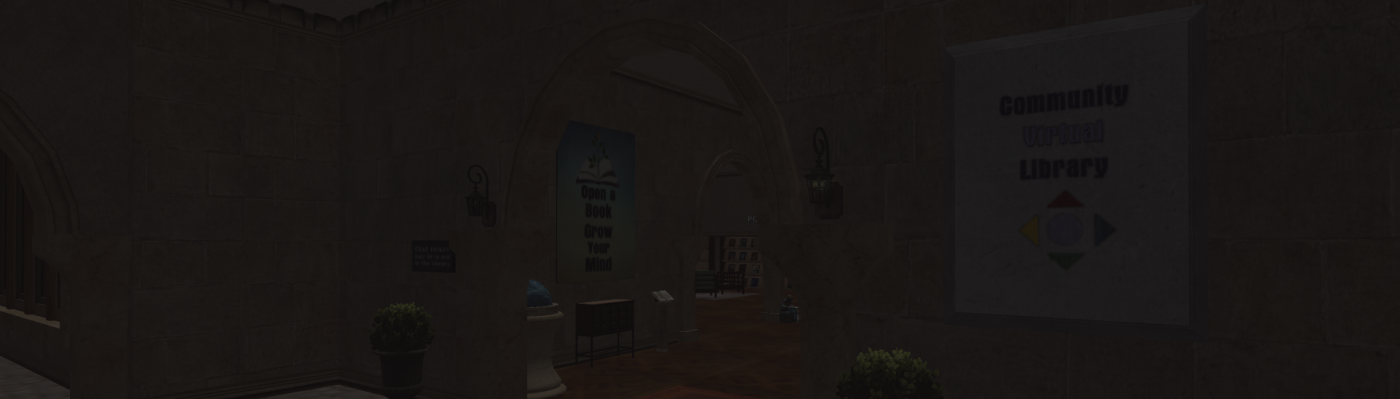

Education in Virtual Worlds is an ever growing field; as librarians we strive to provide easy access to useful materials. Below you will find a curated bibliography you can peruse and, if you would like to contribute, you can do so by filling this Google form. Thank you!
Bibliography of Virtual Worlds for Education
Abdur Rahman, M. (2015). Multisensor Serious Game-Based Therapy Environment for Hemiplegic Patients. International Journal of Distributed Sensor Networks, 2015, 1–12. https://journals.sagepub.com/doi/10.1155/2015/910482
Airtable. (n.d.). Virtual worlds database. Retrieved April 18, 2019, from https://airtable.com/appWViv00dnfs84j5/shriNaffko1IcfYsa/tblLJVb1rIcSabAo5/viwoBSCcrkNsQ6xMD
Andersen, A., Hristov, E., & Karimi, H. (2008). Second Life: New opportunities for higher educational institutions. Bachelor thesis in Business Administration, Jönköping University, 1–65. https://www.diva-portal.org/smash/record.jsf?pid=diva2%3A3785&dswid=-5499
Anstice, I. (2020). 8 Trusting in others: The experience of councils transferring libraries to other organisations since 2010. In Public Library Governance (pp. 166–184). De Gruyter Saur. https://doi.org/10.1515/9783110533323-011
Bainbridge, W. S. (2007). The scientific research potential of virtual worlds. Science, 317(5837), 472–476. https://pubmed.ncbi.nlm.nih.gov/17656715/
Bell, L. (2008, February 5). Virtual Worlds: Libraries, Education and Museums Conference. LIS News. https://www.alsc.ala.org/blog/2008/02/virtual-worlds-libraries-education-and-museums-conference-on-march-8th/
Bell, L., Lindbloom, M., et al. (2008). Virtual libraries and education in virtual worlds: Twenty-first century library services. Policy Futures in Education, 6(1), 49–58. https://journals.sagepub.com/doi/abs/10.2304/pfie.2008.6.1.49
Bell, L., Peters, T., & Pope, K. (2007). Get a (Second) Life!: Prospecting for gold in a 3-D world. Computers in Libraries, 27(1), 10–15. https://www.researchgate.net/publication/234725682_Get_a_Second_Life_Prospecting_for_Gold_in_a_3-D_World
Berger, M., Jucker, A. H., & Locher, M. A. (2016). Interaction and space in the virtual world of Second Life. Journal of Pragmatics, 101, 83–100. https://www.sciencedirect.com/science/article/abs/pii/S0378216616301783
Blankenship, E. F., & Hollingsworth, Y. (2009). Balancing both lives: Issues facing librarians working in Second Life and real life worlds. New Library World, 110(9/10), 430–440. https://doi.org/10.1108/03074800910997445
Calongne, C., Stricker, A., Truman, T., & Arenas, F. (2017). Integrating an awareness of selfhood and society into virtual learning (pp. 180–197). Hershey, PA: IGI Global. https://www.igi-global.com/gateway/book/172441
Calongne, C. (2017). The pioneering spirit in the virtual frontier. In A. Sticker, C. Calongne, B. Truman, & F. Arenas (Eds.), Integrating an Awareness of Selfhood and Society into Virtual Learning (pp. 279–297). Hershey, PA: IGI Global. https://www.igi-global.com/gateway/book/172441
Chen, J. C. (2016). The crossroads of English language learners, task-based instruction, and 3D multi-user virtual learning in Second Life. Computers & Education, 102, 152–171. https://doi.org/10.1016/j.compedu.2016.08.004
Cho, Y. H., & Lim, K. Y. T. (2017). Effectiveness of collaborative learning with 3D virtual worlds. British Journal of Educational Technology, 48(1), 202–211. https://doi.org/10.1111/bjet.12356
Chodos, D., Stroulia, E., et al. (2014). A framework for monitoring instructional environments in a virtual world. British Journal of Educational Technology, 45(1), 24–35. https://doi.org/10.1111/j.1467-8535.2012.01370.x
Conan, M., Karakus, T., et al. (2015). Technical problems experienced in the transformation of virtual worlds into an education environment and coping strategies. Journal of Educational Technology & Society, 18(1), 37–49. https://www.researchgate.net/publication/279319258_Technical_Problems_Experienced_in_the_Transformation_of_Virtual_Worlds_into_an_Education_Environment_and_Coping_Strategies
Cybrary City in Second Life to Showcase Library Resources. (2006, November 13). Information Today – NewsBreaks. Retrieved from http://newsbreaks.infotoday.com/wndReader.asp?ArticleId=186
Davis, D. L., Hercelinskyj, G., & Jackson, L. M. (2016). Promoting interprofessional collaboration: A pilot project using simulation in the virtual world of Second Life. Journal of Research in Interprofessional Practice & Education, 6(2). https://jripe.org/jripe/index.php/journal/article/view/225
Dawley, L. (2009). Social network knowledge construction: Emerging virtual world pedagogy. On the Horizon, 17(2), 109–121. https://doi.org/10.1108/10748120910965494
Digital Citizenship. (2017, February 14). Common Sense Education. Retrieved from https://www.commonsense.org/education/digital-citizenship
Digital Citizenship Museum. (2018, June 1). Community Virtual Library. Retrieved from https://communityvirtuallibrary.org/digital-citizenship-museum/
Dougherty, W. C. (2009). Virtualization and libraries: The future is now. Journal of Academic Librarianship, 35(3), 274–276. https://doi.org/10.1016/j.acalib.2009.03.006
Duncan, I., Miller, A., & Jiang, S. (2012). A taxonomy of virtual worlds usage in education. British Journal of Educational Technology, 43(6), 949–964. https://doi.org/10.1111/j.1467-8535.2011.01263.x
Feihong, W., & Lockee, B. B. (2010). Virtual worlds in distance education: A content analysis study. Quarterly Review of Distance Education, 11(3), 183–186. https://www.researchgate.net/publication/289504622_Virtual_worlds_in_distance_education_A_content_analysis_study
Gallego, M. D., Bueno, S., & Noyes, J. (2016). Second Life adoption in education: A motivational model based on Uses and Gratifications theory. Computers & Education, 100, 81–93. https://doi.org/10.1016/j.compedu.2016.05.001
Ghanbarzadeh, R., & Ghapanchi, A. H. (2018). Investigating various application areas of three-dimensional virtual worlds for higher education. British Journal of Educational Technology, 49(3), 370–384. https://doi.org/10.1111/bjet.12538
Gregory, S., Scutter, S., et al. (2015). Barriers and enablers to the use of virtual worlds in higher education: An exploration of educator perceptions, attitudes and experiences. Journal of Educational Technology & Society, 18(1), 3–12. https://www.researchgate.net/publication/274085377_Barriers_and_Enablers_to_the_Use_of_Virtual_Worlds_in_Higher_Education_An_Exploration_of_Educator_Perceptions_Attitudes_and_Experiences
Hay, L., & Pymm, B. (2010). Real learning in a virtual world: A case study of the School of Information Studies’ learning centre in Second Life. Education for Information, 28(2–4), 187–202. https://doi.org/10.3233/EFI-2010-0901
Haycock, K., & Kemp, J. (2008). Immersive learning environments in parallel universes: Learning through Second Life. School Libraries Worldwide, 14(2), 89–97. https://doi.org/10.29173/slw6782
Heath, B. J., & Williams, K. K. (2018). Creating immersive virtual field trips using 360-degree images and videos. Geological Society of America Abstracts with Programs, 50(6). https://doi.org/10.1130/abs/2018NE-311196
Hedreen, R. C., Johnson, J. L., et al. (2008). Exploring virtual librarianship: Second Life 2.0. Internet Reference Services Quarterly, 13(2–3), 167–195.https://doi.org/10.1080/10875300802103833
Hewett, K. J. E., Pletcher, B. C., & Zeng, G. (2018). The 21st century classroom gamer. Games and Culture. Advance online publication. https://doi.org/10.1177/1555412018762168
Hill, V. (2015). Digital citizenship through game design in Minecraft. New Library World, 116(7/8). https://doi.org/10.1108/NLW-09-2014-0112
Hill, V. (2016). The Community Virtual Library: A decade of virtual world librarianship. Virtual Education Journal, Spring 2016, 53–57. Retrieved from https://issuu.com/edovation/docs/vej_s_2016_mag_upload_opt
Hill, V. (2018). Digital citizenship in virtual . Journal of Virtual Studies, 9(3), 16–22.
Hill, V. J. (2010). Are librarians needed in the metaverse? Texas Library Journal, 86(1), 8–10. https://www.researchgate.net/publication/275715993_Are_Librarians_Needed_in_the_Metaverse
Hill, V. J. (2012). The adoption of virtual media and virtual worlds by librarians. In D. E. Williams & J. Golden (Eds.), Advances in Library Administration and Organization, 31 (pp. 89–119). Emerald. https://doi.org/10.1108/S0732-0671(2012)0000031005
Hill, V. J. (2016). Information literacy in virtual environments: Changing needs of P–12 learners. In D. Russell & J. Laffey (Eds.), Handbook of Research on Gaming Trends in P-12 Education (pp. 165–177). Hershey, PA: Information Science Reference. https://www.irma-international.org/book/handbook-research-gaming-trends-education/137059/
Hill, V. J. (2016). MOOCs, virtual environments, and librarians. In P. Franks, L. Bell, & R. Trueman (Eds.), Teaching and Learning in Virtual Environments: Archives, Museums, and Libraries (pp. 179–195). Hershey, PA: Information Science Reference; Santa Barbara, CA: Libraries Unlimited. https://www.researchgate.net/publication/307908428_Teaching_and_Learning_in_Virtual_Environments_Archives_Museums_and_Libraries
Hill, V. J. (2016). The future of libraries in the digital age. In P. Franks, L. Bell, & R. Trueman (Eds.), Teaching and Learning in Virtual Environments: Archives, Museums and Libraries (pp. 225–235). Hershey, PA: Information Science Reference; Santa Barbara, CA: Libraries Unlimited.https://www.researchgate.net/publication/309155157_The_Future_of_Libraries_in_the_Digital_Age
Hill, V. J. (2017). Digital citizenship in participatory culture. In A. Sticker, C. Calongne, B. Truman, & F. Arenas (Eds.), Integrating an Awareness of Selfhood and Society into Virtual Learning (pp. 60–73). Hershey, PA: IGI Global. https://www.igi-global.com/gateway/chapter/174807
Hill, V. J. (2019, June). Digital citizenship in virtual environments. In Recent advances in applying identity and society awareness to virtual learning (pp. 97–115). IGI Global. https://doi.org/10.4018/978-1-5225-9679-0.ch005
Hill, V. J. (2020). Metamodernism and Changing Literacy: Emerging Research and Opportunities. Hershey, PA: IGI Global. https://doi.org/10.4018/978-1-7998-3534-9
Hill, V. J., & Knutzen, K. B. (2017). Virtual world global collaboration: An educational quest. Information and Learning Science, 118(9/10), 547–565. https://www.researchgate.net/publication/320309091_Virtual_World_Global_Collaboration_An_Educational_Quest
Hill, V., & Brock-Richmond, R. (2015). Exemplifying professional avatar creation through hermeneutic phenomenology. Journal of Virtual Studies, 6(3), 7–23.
Hill, V., & Lee, H. J. (2009). Libraries and immersive learning environments unite in Second Life. Library Hi Tech, 27(3), 338–356. https://doi.org/10.1108/07378830910988487
Hill, V., & Lee, H. J. (2010). Adoption of virtual worlds in libraries: A progress report. Proceedings of the 73rd ASIS&T Annual Meeting, 47(1), Pittsburgh, PA, Oct. 22–27, 2010 (pp. 1–3).
Hill, V., & Lee, H. J. (2010). Libraries and museums in virtual worlds. In Proceedings of the 16th International Conference on Virtual Systems and Multimedia (VSMM 2010) (pp. 386–389). Seoul, South Korea.
Hill, V., & Lee, H. J. (2015). Now and future of virtual libraries and education in Second Life based on diffusion theory. International Journal of Communication and Linguistic Studies, 13(3), 33–47. https://doi.org/10.18848/2327-7882/CGP/v13i03/43652
Hill, V., & Lewis, S. (2016). Future libraries: Will you checkout a virtual reality head mounted display? Journal of Virtual Studies, 7(1), 48–53. http://ejournal.urockcliffe.com/index.php/jovs/issue/viewIssue/10/11
Hill, V. (2017). Digital citizens as writers: New literacies and new responsibilities. In E. A. Monske & K. L. Blair (Eds.), Handbook of research on writing and composing in the age of MOOCs (pp. 56-74). IGI Global. https://www.igi-global.com/gateway/chapter/172579
Hill, V., & Mackey, T. (2020). Embracing metaliteracy: Metamodern libraries and virtual learning communities. College & Research Libraries News, 82(5), 219–222. https://doi.org/10.5860/crln.82.5.219
Hill, V., & Meister, M. (2013). Virtual worlds and libraries. College & Research Libraries News, 74(1), 43–47. https://doi.org/10.5860/crln.74.1.8887
Hill, V., & Webber, S. (2014, October). Digital citizenship: Global perspectives across age levels [Poster presentation]. Poster session presented at the European Conference on Information Literacy, Dubrovnik, Croatia. https://www.researchgate.net/publication/277248349_Digital_Citizenship_Global_Perspectives_Across_Age_Levels
Hill, V., Grassian, E., & Webber, S. (2013, October). Moving toward global information literacy 3.0 [Poster presentation]. Poster session presented at the European Conference on Information Literacy, Istanbul, Turkey. https://www.researchgate.net/publication/277247809_Moving_Toward_Global_Information_Literacy_IL_30
Hill, V. (2017). Digital citizens as writers: New literacies and new responsibilities. In Monske, E. A., & Blair, K. L. Handbook of Research on Writing and Composing in the Age of MOOCs. IGI Global. https://www.igi-global.com/gateway/chapter/172579
Hill, V. & Mystakidis, S. (2012). Maya Island Virtual Museum: A virtual learning environment, museum, and library exhibit. In Proceedings of the 18th International Conference on Virtual Systems and Multimedia (VSMM 2012) (pp. 565–568). Milan, Italy. https://www.researchgate.net/publication/261120863_Maya_Island_virtual_museum_A_virtual_learning_environment_museum_and_library_exhibit
Hinrichs, R., Hill, V., & Patterson, D. (2011). Book review: Higher education in virtual worlds: Teaching and learning in Second Life, edited by Charles Wankel & Jan Kingsley. Information Processing & Management, 47(1), 143–146. https://doi.org/10.1016/j.ipm.2010.04.002
Howard, M., & Wheelock, A. (2015, August). The heir of the king: An epic learning adventure. AMLE Magazine, 40–42.
Hsiao, I. Y. T., Lan, Y., Kao, C., & Li, P. (2018). Visualization analytics for second language vocabulary learning in virtual worlds. Journal of Educational Technology & Society, 20(2), 161–175. https://www.researchgate.net/publication/315885148_Visualization_analytics_for_second_language_vocabulary_learning_in_virtual_worlds
Ives, B., & Piccoli, G. (2007). STA Travel Island: Marketing first life travel services in Second Life. Communications of the Association for Information Systems, 20, Article 28. https://doi.org/10.17705/1CAIS.02028
Jamerson, H. W. (2011). Bringing real justice to virtual worlds. In Virtual communities (pp. 1949–1960). IGI Global. https://doi.org/10.4018/978-1-60960-100-3.ch604
Joint, N. (2008). Virtual reference, Second Life and traditional library enquiry services. Library Review, 57(6), 416–423. https://doi.org/10.1108/00242530810886689
Karaman, M. K., & Özen, S. O. (2016). A survey of students’ experiences on collaborative virtual learning activities based on five-stage model. Journal of Educational Technology & Society, 19(3), 247–259. https://eric.ed.gov/?id=EJ1107189
Kattelman, B. (2008, November 1). It’s time for a Second Life: Resources dedicated to the virtual world. College & Research Libraries News, 69(10), 614–617. https://doi.org/10.5860/crln.69.10.8081
Luo, L., & Kemp, J. (2008). Second Life: Exploring the immersive instructional venue for library and information science education. Journal of Education for Library and Information Science, 49(3), 147–166.https://worldsofeducation.pbworks.com/f/Luo.pdf
Ma, T., Brown, I. A., Kulm, G., Davis, T. J., Lewis, C. W., & Allen, G. D. (2016). Constructing and role-playing student avatars in a simulation of teaching algebra for diverse learners. Urban Education, 51(5), 534–555. https://doi.org/10.1177/0042085914542658
Ma, M., Coward, S., & Walker, C. (2017, March 4). Question-answering virtual humans based on pre-recorded testimonies for Holocaust education. Serious Games and Edutainment Applications (Vol. 2, pp. 391–409). https://doi.org/10.1007/978-3-319-51645-5_18
Mawer, M. (2016). Observational practice in virtual worlds: Revisiting and expanding the methodological discussion. International Journal of Social Research Methodology, 19(2), 161–176. https://doi.org/10.1080/13645579.2014.936738
McArthur, V. (2012). Virtual world professionals and the interloper effect in 3D virtual worlds. In Virtual worlds and metaverse platforms (pp. 321–336). IGI Global. https://doi.org/10.4018/978-1-60960-854-5.ch021
McNicol, S. (2009). Review of the book Virtual worlds, real libraries: Librarians and educators in Second Life and other multi-user virtual environments (L. Bell & R. B. Trueman, Eds.). New Library World, 110(11/12), 571–572. https://doi.org/10.1108/03074800911007613
Merrick, S., & Wheelock, A. (2015, May 5). 5 worlds for engaged learning. ISTE.
Mon, L. M. (2012). Professional avatars: Librarians and educators in virtual worlds. Journal of Documentation, 68(3), 318–329. https://doi.org/10.1108/00220411211225566
Morgan, S. (1998, December). Outsourcing library technical services operations: Practices in academic, public and special libraries. Library Review, 47(8), 412–413. https://doi.org/10.1108/lr.1998.47.8.412.10
Novak, K., Luchs, C., & Davies-Stofka, B. (2013). More than just logging in: A case study of learner engagement and immersion in cross-curricular events in Second Life. In S. D’Agustino (Ed.), Immersive Environments, Augmented Realities, and Virtual Worlds: Assessing Future Trends in Education. Hershey, PA: IGI Global. https://doi.org/10.4018/978-1-4666-2670-6
Novak, K. (2017). It takes a guild – social metacognition and collaborative creation of a learning organization: Massively multiplayer online game. In A. Sticker, C. Calongne, B. Truman, & F. Arenas (Eds.), Integrating an Awareness of Selfhood and Society into Virtual Learning (pp. 198–224). Hershey, PA: IGI Global. https://www.igi-global.com/chapter/it-takes-a-guild–social-metacognition-and-collaborative-creation-of-a-learning-organization/174817
Olasina, G. (2016). Exploratory study of collaborative behaviour in gaming and interactions of students in Second Life. British Journal of Educational Technology, 47(3), 520–527. https://doi.org/10.1111/bjet.12447
Palomeque, C., Pujolà, J., Wigham, C. R., Panichi, L., Nocchi, S., & Sadler, R. (2018). Managing multimodal data in virtual world research for language learning. ReCALL, 30(2), 177–195. https://doi.org/10.1017/S0958344017000374
Parker, K. J. (1998, January 15). Virtual seminars and digital filing cabinets. Science & Technology Libraries, 16(3–4), 115–129. https://doi.org/10.1300/J122v16n03_08
Reaching Across Illinois Library System. (n.d.). Retrieved from http://www.alliancelibrarysystem.com/
Seanchai Library. (n.d.) Welcome to Seanchai Libraries.http://irelandslstory.blogspot.com/
Second Life Maps – Cookie. (n.d.). Retrieved April 18, 2019, from https://maps.secondlife.com/secondlife/Cookie/191/210/21/
Scantlebury, N., & Stevenson, L. (2004). Library services and virtual learning: The DEViL project. In Libraries Without Walls 5 (pp. 49–55). Facet Publishing. https://doi.org/10.29085/9781856047876.005
Shaw, L. (2010). Book review of Higher education in virtual worlds: Teaching and learning in Second Life. Journal of Chemical Education, 87(11), 1141. https://doi.org/10.1021/ed100858d
Shu-Sha Angie, G., Subrahmanyam, K., Linares, K., & Roy, C. (2015). Beauty in the eye of the beholder? Attractiveness in a virtual world. Cyberpsychology: Journal of Psychosocial Research on Cyberspace, 9(2), Article 2. https://doi.org/10.5817/CP2015-2-2
Simpson, J. (2009). Public libraries in Second Life. Library Technology Reports, 45(2), 13–20. https://journals.ala.org/index.php/ltr/article/view/4257/4866
Solo, L. (2015). Adventures in hybrid space. Canadian Theatre Review, 163, 8–13. https://doi.org/10.3138/ctr.163.002
Tan, S.-C., & Wong, Y.-M. (2011). Learning language through immersive storytelling in a 3D virtual environment. In A. Cheney & R. L. Sanders (Eds.), Teaching and learning in 3D immersive worlds: Pedagogical models and constructivist approaches (pp. 211–225). IGI Global. https://doi.org/10.4018/978-1-60960-517-9.ch012
The Community Virtual Library Project. (n.d.). Wikiversity. Retrieved from https://en.wikiversity.org/wiki/The_Community_Virtual_Library_Project
Tokel, S. T., & Isler, V. (2015). Acceptance of virtual worlds as learning space. Innovations in Education & Teaching International, 52(3), 254–264. https://doi.org/10.1080/14703297.2013.820139
Truman, B. (2017). New constructions for understanding using virtual learning – towards transdisciplinarity. In A. Sticker, C. Calongne, B. Truman, & F. Arenas (Eds.), Integrating an Awareness of Selfhood and Society into Virtual Learning (pp. 298–316). Hershey, PA: IGI Global. https://www.igi-global.com/gateway/chapter/174823
University College Dublin. (2007, June 27). Library joins Second Life. UCD News. Retrieved from http://www.ucd.ie/news/june07/062707_second_life.html
University College Dublin. (2007, June 29). UCD opens Ireland’s first library on Second Life. Silicon Republic. Retrieved from https://www.siliconrepublic.com/innovation/ucd-opens-irelands-first-library-on-second-life
Vans, M., Hill, V., & Dunavant-Jones, A. (2018). Improving digital literacy: A solvable challenge using virtual worlds. Journal of Virtual Studies, 9(2), 14–24.
Vojtek, R. B. (Ed.). (2017, February). Virtual Education Journal. Retrieved June 6, 2018, from http://virtualeducationjournal.com/
Wankel, C., & Kingsley, J. (Eds.). (2009). Higher education in virtual worlds: Teaching and learning in Second Life. Emerald Group Publishing.
Wang, Y. F., Petrina, S., & Feng, F. (2017). VILLAGE—Virtual immersive language learning and gaming environment: Immersion and presence. British Journal of Educational Technology, 48(2), 431–450. https://doi.org/10.1111/bjet.12388
Warburton, S. (2009). Second Life in higher education: Assessing the potential for and the barriers to deploying virtual worlds in learning and teaching. British Journal of Educational Technology, 40(3), 414–426. https://doi.org/10.1111/j.1467-8535.2009.00952.x
Ward, T., Falconer, L., Frutos-Perez, M., Williams, B., Johns, J., & Harold, S. (2016). Using virtual online simulations in Second Life to engage undergraduate psychology students with employability issues. British Journal of Educational Technology, 47(5), 918–931. https://doi.org/10.1111/bjet.12307
Webber, S. (2010). Investigating modes of student inquiry in Second Life as part of a blended approach. International Journal of Virtual and Personal Learning Environments, 1(3), 55–70. https://www.igi-global.com/gateway/article/45892
Webber, S. (2013). Blended information behaviour in Second Life. Journal of Information Science, 39(1), 85–100. https://doi.org/10.1177/0165551512469777
Webber, S., & Nahl, D. (2011). Sustaining learning for LIS through use of a virtual world. IFLA Journal, 37(1), 5–15. https://www.researchgate.net/publication/254098217_Sustaining_learning_for_LIS_through_use_of_a_virtual_world
Wheelock, A. (2010, March/April). Social studies in a virtual world. Learning & Leading with Technology, 37(6), 26–27.
Wheelock, A. (2012, May). Immerse your students in history. Learning & Leading with Technology, 39(7), 26–27.
Wheelock, A., & Merrick, S. (2015, February). Fizzle or sizzle: Virtual worlds in education. ISTE Professional Learning Series. https://iste.org/blog/2015-iste-professional-learning-series
Wigham, C. R., & Chanier, T. (2015). Interactions between text chat and audio modalities for L2 communication and feedback in the synthetic world Second Life. Computer Assisted Language Learning, 28(3), 260–283. https://doi.org/10.1080/09588221.2013.851702
Zhang, Y., & Deng, S. (2014). Social question and answer services versus library virtual reference: Evaluation and comparison from the users’ perspective. Information Research: An International Electronic Journal, 19(4). https://files.eric.ed.gov/fulltext/EJ1050455.pdf
 Community Virtual Library